Where Descent Becomes Ground
Basis is formed where descent becomes ground.
Every constitutional system eventually reaches a point beyond which explanation ceases and acceptance begins. There must exist realities that are not inferred from deeper principles but instead serve as the substrate from which all higher reasoning proceeds.
A digital computer expresses this requirement through binary state. A signal is either asserted or it is not. Intermediate ambiguity is not information—it is uncertainty requiring resolution.
Human language operates similarly.
"Let your communication be, Yea, yea; Nay, nay: for whatsoever is more than these cometh of evil."
— Matthew 5:37
Before promises can be trusted, before contracts can bind, before measurements can compare, before memory can preserve, there must first exist statements whose admissibility is independent of persuasion.
Basis therefore concerns itself with constitutional admissibility.
Federation Prime Invariants are selected with exceptional restraint. They are intended to remain legible across generations, technologies, languages, and cultures. They are not immutable because they are old; they are immutable because every higher layer depends upon them remaining stable.
Complexity is permitted.
Ambiguity is sometimes necessary. And to press the matter further, in A/B or similar-type testing, multiplicity is part of the process.
But neither may alter the substrate upon which comprehension itself depends.
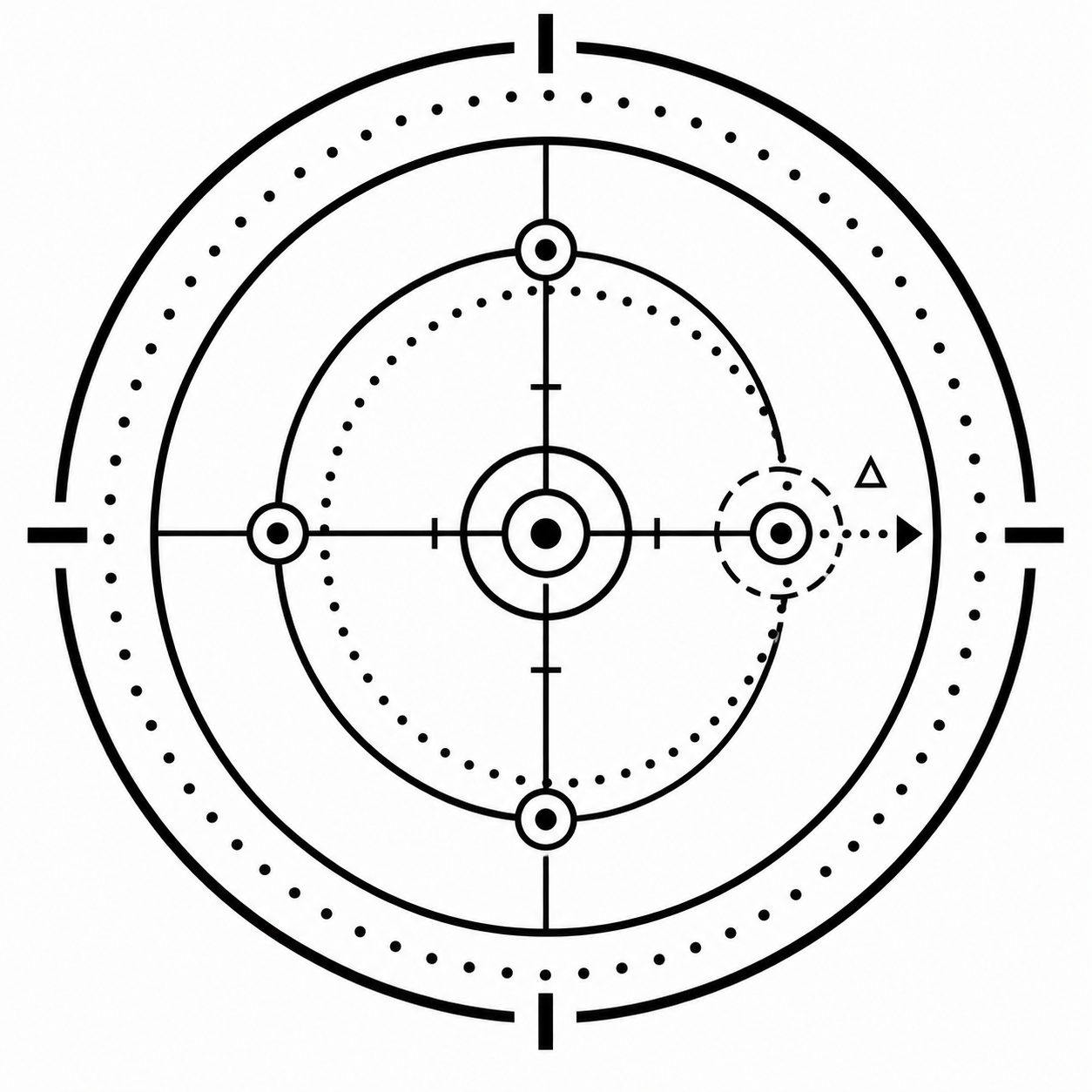
EMS does not eliminate complexity, ambiguity, or multiplicity. It renders their movement observable against an invariant reference. Variation is monitored across state transitions; material deviation is detected, measured, and flagged before it can enter the substrate as silent drift. A flag is not a rejection. It places the variance into examination, where it may be admitted, recorded, repaired, or returned to its last stable orientation.
The first glyph shows continuity retained between states: origin and destination remain connected even when the longer path of return and renewed passage becomes necessary.
The second shows the monitoring field more explicitly:
the center supplies invariant reference;
concentric boundaries define admissible envelopes;
fixed points preserve orientation;
the moving state is compared against the reference;
the triangle marks detected variance;
the outward arrow indicates attempted passage;
the dashed enclosure shows examination or provisional hold.
EMS monitors relational change, not surface difference.
And the anti-drift rule:
Variance does not become substrate through non-detection, nor does identity detection by an unauthorized witness confer admissibility.